News
Most AI models see data as dots and connections, like a subway map where stations are linked by lines. That works for many things, but not for everything. Molecules have spatial shapes, social networks form clusters rather than just pairs, and sensor data changes its structure over time. All of this gets lost when you only look at dots and lines.
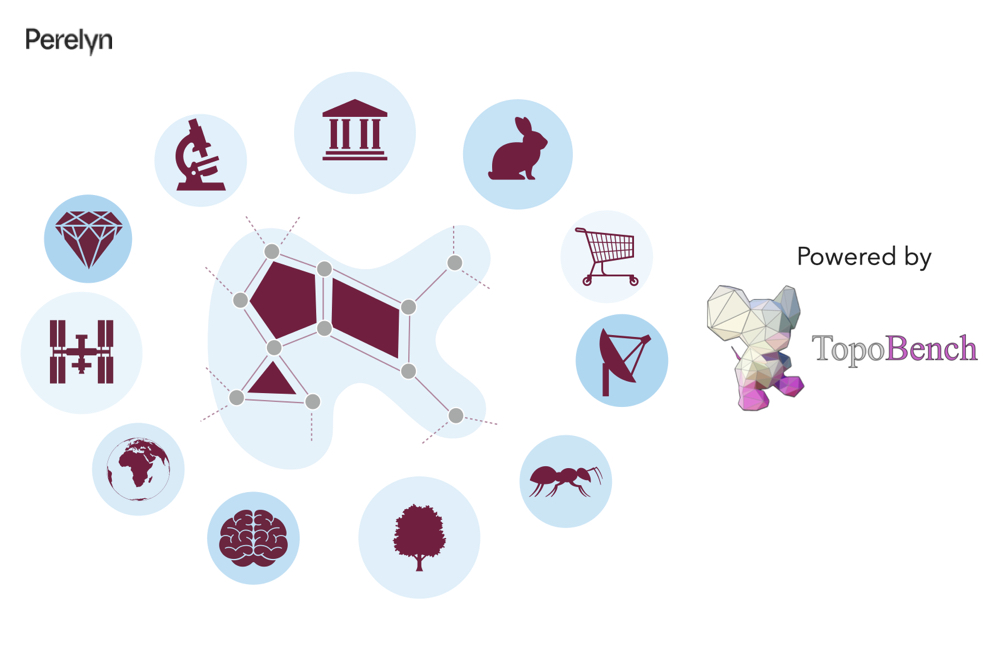
Topological Deep Learning extends classical models so that AI can recognise not just connections, but also shapes, surfaces and spatial structures in data. The Topological Deep Learning Challenge brings researchers from around the world together to develop new methods for exactly this task. The results of the 2025 edition have now been published as a community paper in the Proceedings of Machine Learning Research and presented at the first Topology, Algebra, and Geometry in Data Science Conference (TAG-DS). The methods feed into TopoBench, an open Python library that standardises benchmarking in Topological Deep Learning and makes it accessible to the entire research community.
Two of the co-authors are part of our team: Dominik Filipiak and Michael Banf.
At Perelyn, these things go hand in hand. We don't just want to apply AI, we want to understand what it's built on. That also means contributing where new knowledge is created.
Research at heart. Business in mind.
Read the paper here.
Event

Liliya Imasheva presented a validation pipeline for evaluating AI summaries at Conf42 Large Language Models 2026.
Event

At the IOCMA 2026 conference, Perelyn presented our method, which transforms graph data such as supply chains or networks so that AI models can learn more reliably from it, even over long distances.

